
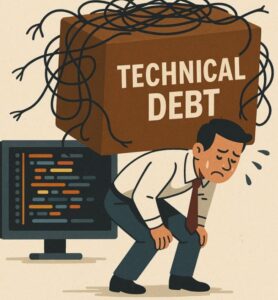
Don’t Ignore “Technical Debt”
If you are an IT executive, TPM, or PM, you’ve likely lived through this scenario: a project is racing toward a hard deadline, pressure from stakeholders is building, budgets are tight, and your engineering team is forced to focus only on bare-minimum deliverables. Deep down, you already know this trade-off, postponing certain features, cleanup tasks, or architectural improvements will create bugs, system instability, and future hot fixes that drain more time than they save.
During a recent conversation with a development manager, this very issue surfaced again. That discussion, paired with my own technical instincts, pushed me to explore this topic in depth. What follows is a concise synopsis of my research and practical experience on what happens when IT technical debt is ignored.
Ignoring IT technical debt creates a chain of negative consequences that impact speed, cost, quality, morale, and security posture. Below are key impacts that surface consistently across real-world projects.
- Reduced Agility and Slower Time-to-Market
Accumulated tech debt becomes a drag on velocity. Codebase grows brittle and complex, turning simple changes into slow, risky tasks. Software developers end up navigating old issues rather than building new capabilities. Over time, delivery cycles slow, and their ability to respond to IT industry shifts weakens.
- Increased Costs and Financial Strain
Technical debt carries interest, and it compounds.
- Higher maintenance costs: Budget shifts from innovation toward recurring fixes and rework.
- Inefficiency: Architectural friction slows workflows and increases operational labor costs.
- Missed opportunities: Delayed software product delivery leads to lost revenue and weaker competitive positioning.
- Compromised Quality and Reliability
As tech debt grows, system quality erodes. You see more bugs, more outages, and more fragile app components. Quick fixes stack up, architecture weakens, and customer experience suffers.
- Security Vulnerabilities and Compliance Risks
Outdated systems lack modern cybersecurity controls and patches. Ignored IT tech debt exposes organizations to data breaches, cyberattacks, and compliance issues, all of which carry operational and legal consequences.
- Decreased Engineering Morale and Higher Turnover
Working in a brittle, outdated, frustrating codebase (“technical bankruptcy”) damages morale. Engineers want to build, not constantly firefight. Over time, burnout rises, engagement drops, and retaining top technical talent becomes difficult.
Practical Field Note
In one project I supported, engineering kept postponing routine cleanup to meet constant delivery pressure. At first, everything looked stable, features shipped, and deadlines stayed intact. But small bugs grew, simple changes became slow and risky, and a minor enhancement eventually triggered a significant outage. That moment reinforced a simple truth: ignored tech debt always returns, and cost of it is never small.
My Comments
Technical debt is not an engineering inconvenience, rather it is a strategic risk. When IT leadership pushes teams to deliver without allocating time for cleanup, stabilization, and architectural care, organizations pay a much higher price later. The most successful IT leaders treat technical debt as an ongoing responsibility, and not a one-time task. Addressing it consistently, sprint after sprint, protects velocity, product quality, and long-term team health.