Listening to conversations about Artificial Intelligence (AI) across different forum, professional and personal, I sometimes find myself concerned about direction of discussion.
My concern is not with technology itself. AI represents one of the most significant advancements of our generation and has tremendous potential to improve how we work, create, learn, and solve complex problems. However, as AI becomes a widely discussed topic and frequent buzzword, there is growing risk that excitement can sometimes move faster than understanding.
In some of those conversations, AI is portrayed as a shortcut to replace human effort, eliminate need for expertise, or automate thinking itself. From generating content and manipulating images to producing code and supporting decisions, capabilities are impressive, however that capability alone does not equal responsible use.
Most important question is not simply: “What can AI do?”
A far more important question is:
“How should we use AI responsibly while preserving human judgment, creativity, and accountability?”
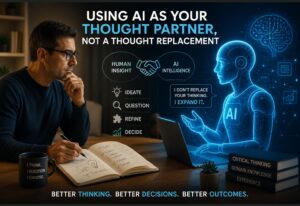
My perspective on AI is built around a balanced and cautious approach. I do not see AI as a replacement for human thought. Instead, I see it as a powerful thought partner, one capable of helping us explore ideas, challenge assumptions, accelerate learning, and improve decision-making.
Responsibility for understanding context, validating information, recognizing nuance, and making final decisions, however, remains firmly with us (Humans).
This perspective led me to write this dialogue; exploring how AI can become a trusted partner in our thinking process rather than a substitute for critical thinking, the very skill that defines professional expertise.
Professionally, a good thought partner never tells us what to think. Raher that ‘good thought partner’ helps us think more clearly.
Using AI as a thought partner means offloading low-value, preparatory work while keeping human judgment, experience, and oversight at center of every decision. It allows us (Humans) to treat AI as a collaborative sounding board rather than an unquestioned authority.
When it’s used this way, AI strengthens cognitive capability instead of replacing it.
Core Difference
| AI as Thought Replacement | AI as Thought Partner |
| Goal: Delegate entire thinking and creation process. | Goal: Expand your capabilities and accelerate your own ideas. |
| Interaction: “Write a strategy for my new project.” | Interaction: “Here is my strategy. Stress-test it. Where am I naïve? What am I missing?” |
| Result: Passive consumption that gradually weakens critical thinking. | Result: Deeper reflection that exposes blind spots and sharpens your perspective. |
Using AI as a Collaborative Colleague
To elevate AI from a sophisticated search engine into a genuine thinking partner, consider using conversational frameworks that encourage analysis instead of simple answers.
Stress-Test Your Assumptions. Ask AI to play devil’s advocate.
Examples include:
- What are three counterarguments to my strategy?
- What assumptions or cognitive biases might be influencing my thinking?
- If this project fails, what will likely be primary reason?
Constructive disagreement often reveals risks long before they become expensive mistakes.
Apply Feynman’s Technique – Explain a concept, proposal, or draft in your own words, then ask AI to identify logical gaps or summarize your reasoning.
If AI cannot clearly explain your idea, there is a good chance your audience may struggle as well.
Clarity usually begins with simplifying our own thinking.
Reverse Interviewing
Instead of continuously asking AI questions, ask AI to ‘interview’ you.
For example:
“Act as a world-class advisor. Ask me no more than three questions at a time to uncover blind spots in my project before we continue.”
This transforms AI from an answer generator into a thoughtful coach that guides deeper reflection.
Borrow Ideas from other segments of Industries. Fact is that an innovation frequently occurs when ideas move from one discipline into another.
Ask AI questions such as:
- What lessons from aviation could improve cybersecurity?
- What practices from healthcare could strengthen project management?
- What principles from manufacturing could improve software delivery?
Cross-domain thinking often uncovers solutions that specialists inside a single field overlook.
Protecting Human Authorship
One of AI’s greatest strengths is also one of its greatest risks. Its fluency can be dangerously persuasive.
When AI produces polished language within seconds, it becomes tempting to believe thinking has already been completed. In reality, elegant wording should never be confused with sound reasoning.
Allowing AI to transform vague ideas directly into finished work bypasses an important part of human learning, that is mental effort required to organize thoughts, evaluate alternatives, and develop original insight.
That temporary struggle is not inefficiency. It is how judgment is built.
By allowing AI to process information, organize research, summarize large volumes of data, and challenge our assumptions, we free mental capacity for work that remains uniquely human; exercising wisdom, empathy, ethical reasoning, creativity, strategic thinking, and informed judgment.
Final Thoughts
Artificial Intelligence should never become a substitute for curiosity or critical thinking.
Its greatest value lies in helping us ask better questions, examine our assumptions more carefully, and arrive at stronger conclusions, and not making those conclusions for us.
Technology has always amplified human capability. AI is no different.
Used responsibly, it becomes an exceptional collaborator that accelerates learning, improves productivity, and broadens perspective.
Used carelessly, it risks replacing thoughtful analysis with convenient automation.
Eventually, quality of AI-generated output will never consistently exceed quality of human thinking guiding it.
Perhaps future measure of AI maturity will not be how effectively machines can think for people, but how effectively people learn to think with machines while remaining accountable for every decision they make.
© 2026 Sam Naqvi. All rights reserved.
This article represents original analysis, experience-based observations, and professional perspectives on information technology, leadership, and digital transformation.
No part of this article may be reproduced, distributed, or transmitted in any form or by any means without prior written permission from the author, except for brief quotations used with appropriate attribution.
Please Subscribe for notification of new events and articles