Recently, while researching on another AI topic, I noticed something interesting.
Nearly every discussion is centered on AI models, GPUs, data, or prompting techniques, yet very few acknowledged technologies quietly connecting all of these pieces together. It became increasingly clear that every impressive AI capability, from drafting an email to generating an image or retrieving live information depends on something far less glamorous but equally essential.
That realization prompted me to write this article.
Application Programming Interfaces (APIs) have quietly become connective tissue behind modern AI, allowing cloud-hosted intelligence to communicate with applications, business systems, and end-users in real time.
Artificial intelligence (AI) dominates technology headlines, yet one critical component rarely receives much attention: Application Programming Interfaces (APIs).
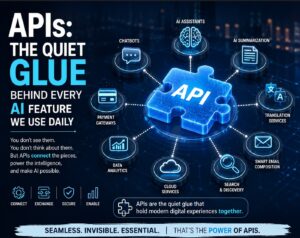
Every time we ask an AI assistant a question, generate an image, summarize a document, translate text, or automate a business workflow, APIs quietly coordinate countless interactions behind scenes. They are invisible connectors allowing modern AI to communicate with applications, cloud services, databases, and devices in real time.
Simply put, AI provides intelligence. APIs make that intelligence accessible.
Why APIs Matter More Than Most People Realize
Many people assume AI lives inside applications they use every day. Reality is quite different.
Large Language Models (LLMs) operate inside massive cloud data centers, requiring enormous computational resources that would be impossible for a typical laptop or smartphone to provide. When we interact with AI, our application sends a request through an API, cloud-hosted AI processes it, and response returns almost instantly.
Without APIs, every AI capability would remain isolated inside its own environment.
In many ways, AI is brilliant brain residing inside cloud infrastructure, while APIs serve as nervous system connecting that intelligence to software, business systems, and end-users.
Three Ways APIs Quietly Power Modern AI
- Connecting Intelligence to Everyday Applications
APIs create communication channel between AI models and software we use every day.
Whether drafting an email, generating meeting notes, translating languages, or creating images inside design software, APIs allow applications to send requests to cloud-hosted AI models and receive responses within seconds.
This architecture allows lightweight applications to leverage enormous computing power without requiring powerful local hardware.
- Giving AI Real-Time Awareness
AI models are trained on historical data, but modern business decisions often require current information.
APIs bridge that gap by allowing AI to retrieve live information from external systems.
Examples include:
- Searching current web content
- Retrieving weather information
- Accessing financial records
- Checking inventory levels
- Reading business databases
- Looking up customer information
Rather than relying solely on training data, AI becomes capable of responding with current business context.
- Turning Intelligence into Action
Conversation by itself delivers limited business value.
Real productivity begins when AI can perform actions.
APIs allow AI to interact with calendars, email systems, CRM platforms, ticketing systems, collaboration tools, and countless enterprise applications.
Imagine asking an AI assistant:
“Schedule a meeting with project team, summarize yesterday’s discussion, and email action items.”
Behind a single request, multiple APIs work together to retrieve calendar availability, generate summary, create meeting invitation, and deliver email.
To users, interaction feels effortless. Behind scenes, APIs orchestrate entire workflow.
APIs Also Enable Scale
Another often-overlooked advantage is economics.
Organizations rarely host large AI models themselves. Instead, they access AI capabilities through cloud APIs and pay only for what they consume, typically based on tokens or processing volume.
This approach dramatically lowers barriers to innovation.
Instead of building and maintaining sophisticated machine learning (ML) infrastructure, software developers can integrate advanced AI capabilities into existing applications with relatively little effort.
Many AI-powered products people use every day rely on this model, allowing organizations to innovate quickly without managing enormous infrastructure investments.
Security Matters Just as Much
Every API interaction involves data moving between systems.
That makes authentication, authorization, encryption, and governance essential components of responsible AI implementation.
Modern AI platforms increasingly support capabilities such as OAuth authentication, client-side encryption, Bring Your Own Key (BYOK), and other privacy-focused controls designed to help organizations protect sensitive information while still benefiting from AI services.
As AI adoption continues growing, secure API design becomes just as important as model quality.
Looking Beyond AI Models
AI models often receive most public attention, however they rarely operate alone.
Every successful AI experience depends on an ecosystem of services working together behind scenes. APIs quietly connect applications, cloud platforms, enterprise systems, and external services into a unified experience that appears seamless to end-users.
They may never appear in product demonstrations or marketing campaigns, yet they remain one of most important architectural building blocks in modern software.
Perhaps greatest compliment an API can receive is that end users never realize it exists.
That is precisely why APIs deserve far more recognition than they typically receive.
Because behind nearly every intelligent application we enjoy today, APIs are quietly doing their job connecting intelligence, enabling communication, and transforming isolated technologies into truly intelligent systems.
© 2026 Sam Naqvi. All rights reserved.
This article represents original analysis, experience-based observations, and professional perspectives on information technology, leadership, and digital transformation.
No part of this article may be reproduced, distributed, or transmitted in any form or by any means without prior written permission from the author, except for brief quotations used with appropriate attribution.