Before We Get Technical…
Why are we revisiting some of the foundational cloud concepts when so much of our recent discussion has focused on Artificial Intelligence?
Because technology doesn’t operate in isolation. AI, modern applications, enterprise platforms, and digital transformation all rely on infrastructure and service models that many of us have been using for years.
Sometimes, moving forward also means revisiting information technology fundamentals.
And that’s exactly why we’re bringing back this three-part IaaS, PaaS, and SaaS series, delivered in easy-to-consume instalments for you all.
First Episode
IaaS & AI – Building a Solid Foundation for Intelligence
I have been thinking for a while driven by recent professional situations and many conversations to write a clear, comprehensive piece on how AI workloads are accelerating infrastructure needs and how Infrastructure as a Service (IaaS) providers enable scalable AI deployment. This topic keeps resurfacing because organizations are feeling real pressure: AI models are growing fast, infrastructure demands are intensifying, and IT leadership teams are asking how to prepare.
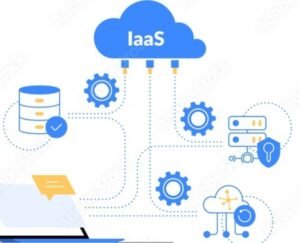
IaaS provides a scalable, essential foundation for artificial intelligence (AI), functioning as an engine room for modern intelligent systems. When IT organizations talk about “AI capability,” what they really rely on is infrastructure strength, flexibility, and capacity. The relationship between IaaS and AI is mutually reinforcing: IaaS supplies raw computational horsepower that AI consumes, while AI increasingly manages complexity behind large infrastructure footprints.
Role of IaaS in Powering AI
AI workloads are unlike classic enterprise applications. Their characteristics push infrastructure boundaries in unique ways:
- They run parallel computations across thousands of cores.
- They ingest and shift data at speeds many networks were never designed for.
- They require fast, elastic storage to hold training datasets that can expand rapidly.
IaaS addresses these constraints with purpose-built capabilities:
- Scalability on Demand
AI workloads fluctuate dramatically (Scalable). One training run may demand thousands of Graphic Processing Unit (GPU) cores, while inference workloads may need modest, steady throughput. IaaS removes physical limitations by enabling rapid scaling in either direction.
This means that engineering teams can run massive experiments today, then scale back tomorrow without ‘sunk cost’.
- Access to Specialized Hardware
Deep learning thrives on specialized acceleration. IaaS providers now offer GPU clusters, TPU-based systems, and high-performance interconnects designed to reduce latency between processing nodes. This hardware tier was previously available only to hyperscalers; now it is accessible to any organization with a cloud account.
- Cost Efficiency and Operational Freedom
Building an on-prem data center that can support AI-level computation is capital intensive. IaaS converts that burden into an operating model i.e. businesses pay only for what they consume, freeing IT leadership from hardware lifecycle management and infrastructure refresh cycles.
AI as an IaaS Operator
As AI becomes mainstream, cloud providers are increasingly applying AI to optimize their IaaS platforms themselves. This shift is significant: AI is no longer just a workload running on infrastructure, rather it is part of how infrastructure operates.
- Predictive Maintenance
Data center hardware generates huge telemetry streams, temperatures, voltage anomalies, performance degradation signals. AI models analyze these patterns and predict failures before they occur, helping minimize downtime and reduce replacement cost.
- Resource Optimization
Intelligent scheduling algorithms place workloads on optimal compute nodes, improve VM density, and continually balance resources across clusters. This leads to better utilization and smoother performance for customers running AI workloads at scale.
- Energy and Cooling Efficiency
Data centers consume enormous amounts of energy. AI-driven systems now adjust cooling systems dynamically, optimize airflow, and fine-tune power distribution.
This not only reduces operational cost but also supports sustainability goals a growing priority across IT industry.
Building an Intelligent Future
IaaS is no longer simply a technical foundation; it is a strategic mechanism for enabling AI-driven transformation. As models grow larger and demand for inference increases across every industry:
- Healthcare systems will rely on AI to accelerate diagnoses.
- Finance will lean on real-time intelligence for fraud detection and risk modeling.
- Logistics and manufacturing will use AI to orchestrate complex, adaptive operations.
A quick wrap Up
IaaS has evolved from a supporting layer to a strategic foundation powering modern AI. As models grow larger and workloads become more dynamic, this partnership between IaaS and AI will continue shaping how organizations operate and innovate. A natural next step in this exploration is shifting my focus upward in this stack, toward SaaS & AI: Enhancing Services, Shaping Experiences, where AI is redefining how products deliver value to customers.
Coming Up Soon: Our exploration of AI and cloud continues. We’ll move up the cloud service stack to examine how Platform as a Service (PaaS) and Software as a Service (SaaS) are evolving in the AI era, and what these changes mean for organizations and their customers. We will ease in this process.
© 2026 Sam Naqvi. All rights reserved.
This article represents original analysis, experience-based observations, and professional perspectives on information technology, leadership, and digital transformation.
No part of this article may be reproduced, distributed, or transmitted in any form or by any means without prior written permission from the author, except for brief quotations used with appropriate attribution.