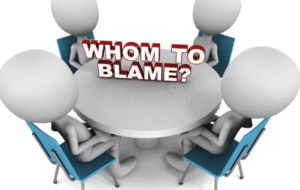
A recent conversation with a professional (IT) friend, a Technical Project Manager brought this question back in our focus: When AI gets it wrong, who takes the blame?
That exchange, combined with my own experience working with Dev Managers during a project, pushed me to explore this further. What follows is a concise synthesis of reflection, research, and real-world observations.
When artificial intelligence makes a mistake ranging from biased hiring decisions to fatal autonomous vehicle errors, responsibility does not lie with machine itself. Current legal frameworks treat AI as property, not a legal “person.” As a result, liability falls on humans and organizations involved in its creation, deployment, and use.
As AI systems become more complex and autonomous, accountability becomes less clear. In most cases, responsibility is shared across multiple stakeholders i.e. developers, deployers, and end users.
- Deployer: “If You Use It, You’re Responsible”
In most business scenarios, organization deploying AI bears primary responsibility for outcomes.
- Operational accountability: Companies integrating AI into customer-facing roles (loan approvals, chatbots) are liable for outputs, just as they would be for human employees.
- Case in point: A court upheld a claim against an airline when its chatbot provided incorrect information, reinforcing that automated systems do not absolve organizational responsibility.
- Negligence risk: A failure to audit for bias or lack of adequate human oversight can lead to liability.
- Developers: “You Built It, You Own It”
Developers and AI vendors carry responsibility when failures originate from system design.
- Defective design or dataset: Models trained on biased, incomplete, or flawed data can produce harmful outcomes, placing accountability on creators.
- Black box challenge: When decision pathways cannot be explained, tracing fault becomes difficult. Still, expectation remains, developers must design for transparency, safety, and traceability.
- End Users: “You Were Still in the Loop”
Human oversight does not disappear with AI, it becomes more critical.
- Failure to intervene: If user is expected to supervise AI but ignores warnings or signals, responsibility shifts.
- Examples: A doctor disregarding diagnostic alerts or a driver ignoring system warnings still holds accountability for resulting outcomes.
Closing Thought
AI does not eliminate responsibility—it redistributes it.
That redistribution introduces a deeper challenge:
- When outputs are co-created, ownership becomes ambiguous
- When trust in AI is mis-calibrated, risk increases
- When decisions cannot be traced, accountability weakens
Therefore, question is no longer whether AI gets it wrong.
It is whether organizations are prepared to answer, clearly and confidently, who is responsible when it does.
Case in point: In a 2018 self-driving car fatality, a human operator was held responsible for not paying attention, blurring line between human error and machine failure.
Responsibility Gap and Emerging Regulations
As AI systems gain autonomy, a responsibility gap begins to emerge where each stakeholder can deflect blame, especially when systems continue learning after deployment.
Regulators are starting to close this gap.
Frameworks like EU AI Act treat high-risk AI as regulated products, with strict expectations around:
- Transparency
- Data governance
- Human oversight
Bottom Line
When algorithm fails, human hands pay price.
Future of AI liability is not about removing human responsibility, rather it is about clearly identifying which human, i.e. developer, deployer, or end user was in best position to prevent harm.
© 2026 Sam Naqvi. All rights reserved.
This article represents original analysis, experience-based observations, and professional perspectives on information technology, leadership, and digital transformation.
No part of this article may be reproduced, distributed, or transmitted in any form or by any means without prior written permission from the author, except for brief quotations used with appropriate attribution.